Thursday, September 24, 2020

Amateur Radio DF Hunting


Amateur direction finding ARDF, also known as radio orienteering, radio fox hunting and radio-sport, is an amateur radio sport that combines with the map and compass skills of orienteering.

One or two hidden transmitters will be located within a specified area designated by the A3 map supplied. The hidden transmitters may be hidden in diverse wooded terrain, a field, a ruin, or maybe even in a farm building.

Note: that, in the event of a Two Fox hunt, only one station may be audible from the vicinity of the starting point

Equipment Required

1)      A 2metre receiver, can be a handheld radio or a receiver specially made for the purpose.

2)      A directional antenna such as a Yagi antenna or purpose built variant.

3)      Magnetic Compass or Handheld GPS

4)      Some means of signal reduction in the case of strong signal reception (an Attenuator)

Rules

1)     Each participant is issued with a topographical map of an area of the county in which the fox may be located. The location of the start will be clearly marked. The location of the meeting place for those who have completed the course will also be clearly marked. These will have no relevance to the position of the hidden transmitter.

2)   The event will start at a specific Time from an appointed location. All participants must sign in at this location. The event will end at a specified time. All operators will congregate at a designated finish point for refreshments and prizegiving.

3)      Competitors must plot their bearings on the map provided.

4)    The Fox will make a transmission of 1-minute duration at 5-minute intervals this may be a voice transmission or an Audio CW signal superimposed on the FM carrier.

In the event of a two-fox hunt, the transmissions will be made at alternate 10-minute intervals, Fox 1 will transmit at the top of the hour and Fox 2 will transmit 5 minutes later and so on. Each fox will clearly identify as Fox 1 or Fox 2.

5)    Those finding the fox will be issued with a ticket with a time printed on it. The Fox will not give any indication as to whether they have already been located.

6)    To qualify as a winner, the map provided, should clearly show the bearings plotted to derive the location of the Fox.

7)   Once the competitor has found the Fox, they will vacate the area immediately.

8) If both Foxes have been found the competitor should proceed immediately to the designated finish point which may be a Bar, Restaurant or Picnic Area.

Typical map with bearings drawn in from the Hunter’s point of view – the supplied map will have more detail.

Not always going to be as easy as the map above but this map illustrates the basic idea of taking bearings and finding the Fox. Note magnetic variation must be taken into account when taking bearings.

Naturally, things become more difficult as you get closer in as it is harder to get a bearing on a very strong signal. Signal reduction is essential for the final stages of capture.

There are numerous resources for antenna design and design of the attenuator to be found on the internet. The order of the day is not to make things too complicated!

Thursday, August 20, 2020

CQ-IRELAND Wires-X Network


The Yaesu Fusion Wires-X Room, CQ-IRELAND, was established two years ago. The intention was to link the Galway Repeater, EI2TBR, and the Salthill Gateway, EI2SHD, and gather interest from other Irish C4FM users. Occasionally, stations from other parts of the world would call in but seldom got a response as there were very few linked to the Node.

An alternative C4FM system "YSF" was bridged to the CQ-IRELAND Room in the hope that a little more traffic would occur. This YSF node, IE.YSF.IRELAND allowed users of a personal "hotspot" to connect into the CQ-IRELAND Wires-X ROOM. DMR Talk Group 2724 was bridged to IE.YSF. IRELAND and more recently, D-Star Reflector XLX 353 E. Having linked three digital modes to the one area would be guaranteed to encourage more activity. An added feature is the inclusion of a link from the Peanut APP using Peanut Room YSF.IRE. Check the Yellow Graphic below to see all of the bridges and connections into CQ IRELAND.

Considering the amount of Digital activity in Ireland, this initiative would maximise the use of the respective DMR Talk Group 2724, D-Star Reflector XLX 353 E, YSF Node, and CQ-IRELAND.

In July, the Galway repeater was moved to a new site in Loughrea, Co. Galway making the Wires-X more accessible in the County and surrounding areas. By accessing the EI2SHD Wires-X node, handheld access from Galway City connection into a wider network was possible. Distant stations were now able to take advantage of communication with stations linked to CQ-IRELAND. Stations from other parts of the world could link into CQ-IRELAND. Anyone on holiday would be able to link back to Ireland if near a Repeater with Wires-X installed.

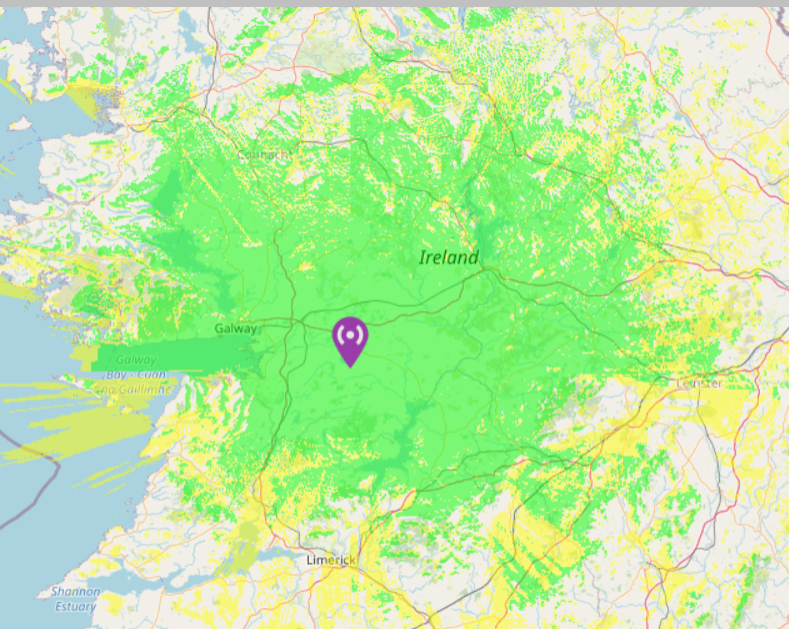
The Galway Fusion Repeater coverage is shown below


The coverage map has proven to be fairly accurate with coverage reports in Westport South of Limerick and beyond Athlone.

The Limerick Clare Amateur Radio Club has two Yaesu Fusion Repeaters, one on 70cms currently active and a second on 2 metres, currently off air. Recently, Dermot, EI2GT, set up a ground station linking Wires-X to the 70cm repeater located at Woodcock Hill, Co. Clare.

The Wires-X software needed to be loaded onto a computer and the firmware updated on the HRi200 modem. Dermot was thrown in the deep end as it is not an easy task to set up the system. The Internet router needed to be set up to pass Data from the Wires-X modem. Once this was set up, the parameters of the modem were tailored to the system. John, MI0AAZ, and Steve, EI5DD were on standby to give assistance if required. Within a day, the system was up and running. Initial tests showed that the modem was connected to the CQ-IRELAND Wires-X room and ready to go on air.

The Galway Repeater and the Salthill Wires-X Gateway were all linked together on CQ-IRELAND and it was now possible to call into the Galway Repeater and have contact via the Limerick Repeater. This was now the beginning of a C4FM network.

It is possible to drive from Galway through Limerick and further South and be in constant contact through both Repeaters. As one leaves the Galway coverage area and moves closer to Limerick, it is necessary to retune to the Limerick Repeater Frequency and still be in constant contact with both the Galway and Limerick areas.

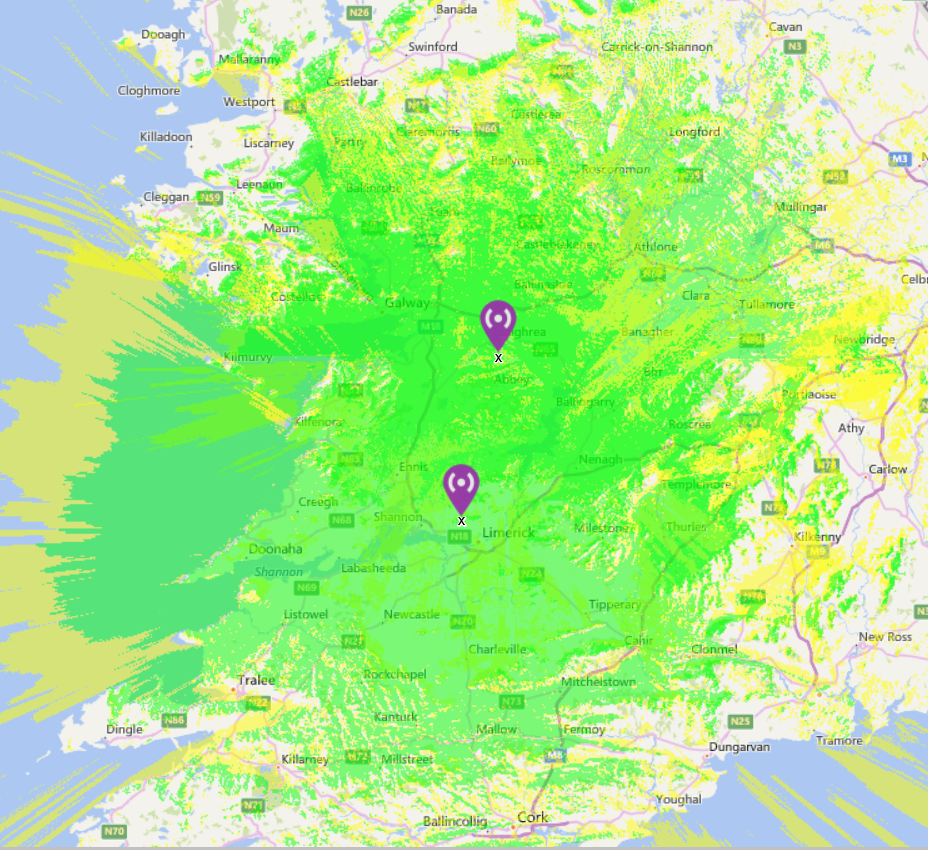
The total coverage of the two repeaters is shown below:


The coverage map above assumes that both repeaters are operating on 2 metres. At present, the Limerick 70 cms repeater is connected but the 2-metre repeater will shortly connect into the network to give the coverage above. By networking via CQ-IRELAND both Galway and Limerick benefit from the additional coverage.

An Email to Peter, EI4JR,  resulted in the Repeater, EI2IPG, connecting into CQ-IRELAND extending coverage even further. There is one more Fusion Repeater, EI2JPG, located at St. John's Point which would be another potential addition to the coverage on the Fusion Network. At present, it does not appear to be connected.


A few stations connect their personal Nodes to the CQ-IRELAND Wires-X room such as GI7ULG, MI0AAZ, EI4ABB, and EI8DJ. Other connections occur at intervals during the day, so it is important to answer anyone good enough to connect to the system.


Other nodes do connect to CQ-IRELAND on a casual basis and contribute to the activity. We do ask that if a station should appear on CQ-IRELAND; please go back and give a report or hold a brief QSO as this will encourage more activity.

The typical Dashboard of a Wires-X node is shown below:


There are a huge number of Wires-X rooms around the world. Just by pressing the "X" button on the Yaesu Fusion Radio, it is possible to select the part of the world you wish to contact. We do ask that if you do change the Wires-X room and hold a QSO elsewhere, please return the system back to CQ-Ireland when you are finished.

Some say that operating a Yaesu Fusion Radio, whilst mobile involves too much button pressing. This is total poppycock! To drive around Galway you can use the repeater in the same way as any other Repeater. Driving from Galway to Limerick using the Wires-X Room CQ-IRELAND does not require button-pushing as the Repeaters are already set up on it. As you move from the coverage area of Galway into the Limerick area you only have to retune to the Limerick Repeater. One would have done this anyway on the Analog system. The only difference is that whichever repeater that you are on, you will have full coverage in both the Limerick and Galway areas as they are linked. There is no button pushing involved.

Analog FM contacts can be made through any Yaesu Fusion Repeater as they have the AMS system employed. If you transmit Analog the repeater will work in Analog. If you transmit in C4FM the Repeater will work in the C4FM Mode. When the Repeater is connected to CQ-IRELAND you will be able to work stations connected to the network using C4FM.

A lot of time and effort has been put into making this network successful so do, please, make a few contacts and encourage others to join in. If you have a Wires-X modem, do feel free to join the network on CQ-Ireland.

Saturday, July 11, 2020

Phase IV Loughrea DMR Repeater Now On Air - Network Complete.

On Saturday the 11th of July The fourth DMR Repeater, EI7LRD, was installed on-site at Knockroe, Loughrea Co Galway. Steve, EI5DD, had the Repeater running on the bench for the previous week prior to installation. at 11:00am Aengus, EI4ABB and Steve loaded up the equipment destined for the Loughrea site. Following the drive to Loughrea we met up with Des, EI5GT.

After the equipment was unloaded, there was a trek to the top of the hill. Fortunately, the load was not too heavy and could be carried among three people.  


This is the location at the top of the hill with the antenna already rigged some months beforehand. Our antenna was at the very top of the tower. Weather and the COVID-19 lockdown had prevented our travel to the site. Steve, EI5DD, was stuck in the UK for 3 months which delayed the installation further. Two possible dates were suggested but the weather was not great so they were abandoned. Despite the cloud as seen in the picture the weather was turned out to be sunny and very warm.


The antennas were already installed and initial SWR checks revealed all was well. Aengus tuned the cavity filters into the antenna system to ensure that there was no desense to the received signal. Whilst tuned into a perfect load at ground level it is always wise to fine-tune into the system on-site as the impedance may vary and the notches may be slightly off frequency. Aengus has this technique down to a fine art at this stage and the tuning was completed within 10 minutes. Aengus is an invaluable member of our team.


Whilst Aengus was finalising the Cavity tune-up, Des was busy connecting up the remote power controller. This system was installed to allow the Repeaters to be switched on or off remotely as required. Once the power controller was installed it was possible to install the DM Repeater.

The 2 metre Fusion Repeater had been installed on-site a few weeks earlier and there were good reports from many far-reaching areas such as Westport, Roscommon, Kinnegad, Mullingar, Kildare and South of Limerick. We were hoping that the 70cms would cover a good distance also.

Our 70cm DMR Repeater fitted into the 19" rack perfectly along with the power supply and Procom Filters. The 2m fusion repeater is located at the bottom of the stack with its cavity filters below. Next is the Hytera power supply. and the Repeater above. The power controller sits above the Repeater and the Router above.


Power was applied to the Repeater and the system booted up without any problems. It was necessary to apply a few changes to the Repeater's internal Programmming to ensure that there was connection ot the Brandmeister DMR Server. 


Adjustment of all parametes is possible via a programming lead. A fineal check of everything before turning up the power to 40 Watts and this concluded the installation.

A quick peek at the SYSOP's dashboard on the Brandmeister Netowk showed that all Galway devices were now connected.The Green Circle shows that everything is connected and the little green plug symbols to the left indicate the individual item that is registering on the Brandmeister Server.


This was the view from the bottom of the tower.


A few shots of the horizon were taken as follows:


This was the view towards Clifden with the Connemara mountains to the right.


The view towards Mayo was clear and it is possible to make out Croagh Patrick on the Horizon. North East is also very clear.


Finally the view due East was very flat so coverage is expected to be good in that direction also.


Our Predicted coverage for the EI7LRD Repeater is shown above. This should produce some excellent results for mobile operators.


Combining the Coverage of the entire Galway Network, it can be seen that we will have achieved a good wide area from a mobile operator's perspective. Base operators, from distant locations, may find a way into the system.


The map above shows the Galway and the Waterford DMR facilities. Dundalk may have a Multi-mode Digital Repeater shortly and it is possible that the Cork Area will also be covered with an additional Repeater from the Southern Ireland Repeater Group

Roaming can be set up on commercial radios and also on the Anytone 578 series radios. It is possible to move seamlessly from one coverage area to another with the radio automatically selecting the repeater with the best signal strength.

In Conclusion:

Tests on the journey home showed that all was working well. Further tests will be carried out with the roaming between repeaters to see how well this system works.

We are confident that this Network will serve us well and look forward to the activity it will bring to the Galway area. Special thanks to all involved in the set up of the network, the guys that put up the antennas, and the site owners for giving us the use of their facilities. 

Many said that Digital Radio was going nowhere in Ireland - at this stage we have proven them wrong many times over!

Thursday, June 18, 2020

The Galway Fusion Repeater Active from Loughrea Co. Galway

On Saturday the 13th of June The Galway Repeater, EI2TBR, was installed on site at Knockroe, Loughrea Co Galway. Aengus, EI4ABB, had prepared the repeater and tuned the cavities before transporting the equipment to the hill. The Repeater was switched on early in the afternoon. The input frequency is 145.025 MHz  and the output is 145.625 MHz. CTCss tones of 77Hz are required to access the analog side. 77Hz tones are also transmitted to open the squelch on an analog radio.


There was no convenient road to the site so the equipment was loaded onto a quad bike which was just about the right size to tranport the equipment to the top of the hill. Des EI5GT is pictured next to the Quad bike.


The antennas had been placed on the tower last March but our attempts to put up the equipment were thwarted initially by weather and then by the introduction of "lockdown" due the COVID-19 Pandemic.

The equipment was driven up the steep hil and off-loaded into the hut which houses the local wireless internet services.  Enda EI2II was preparing the Hut for the installation.


The antenna feeders were already in place and it was easy to install the repeater into the rack system provided. There will be  plenty of space for the UHF DMR repeater in the same rack.


The antenna was a perfect match and it was necessary for Aengus to fine tune the Bandpass/Band Reject Cavity filters. This is a delicate operation as it prevents the transmitted signal from desensitizing the receiver. Aengus is able to do this remarkably quickly on site with a small signal generator that transmits a very weak signal on the input and output frequencies.

The Repeater powered up straight away with no problems. Initial reports were good with the furthest coming from Castlebar Co. Mayo.

The site has an impressive view in all directions although slightly shielded to the South-South-West. As the day continued, calls were received from Inishbofin Island, Galway, Ballinasloe, the Limerick direction, Woodcock Hill, Westport, and we even had a S2 report from Kildare. This would be borne out by the predicted coverage map below. Unfortunately the road map only show coverage extending to 150 Km whereas the satellite map shows coverage extending to a maximum of 250 Km.


There are numerous places where a little bit elevation will allow a station to get in. The maps are based on mobile coverage so base station access would be able to get in from the yellow shaded areas.
The Repeater has EchoLink attached to the Analog side and Wires-X on C4FM. The Wires-X is fed remotely to the site from Galway City. It will be interesting to see how the Wires-X works over the next few months.

The repeater was funded by a joint effort between the Galway Radio Club and the Galway VHF Group plus some amateurs from the Mayo area  and was suppied by John MI0AAZ.

We thank Des, EI5GT, and Enda EI2II for the kind assistance with placement of the antennas and the accomodation of equipment on their site. This has widened the coverage area on 2 metres and will surely gather more interest over time.

Monday, May 25, 2020

Use of the Galway DMR Repeater Network


The new layout of the Galway Digital Network will spread the activity more evenly between the two Time Slots on the four Repeaters in Co Galway.

National Calling - is on the Irish Calling Channel TG 2722. TG 2722 is set up as a Static Talk Group on all National Repeaters. Any call on TG 2722 will be heard on all EI Repeaters at once. 

Where possible QSY, once the contact is established, to TG 2723 which is located on Time Slot 1. This will free up the Calling Channel and Time Slot 2. 

Please do not use TG2723 on Slot 2 of the Galway Network

Local Network QSOs and Calls via the Galway Digital Radio Group Cluster   

TG 8 is the Local Galway Digital Radio Group Cluster. Any QSO or Call made on TG 8, when accessed on a Repeater in the Galway Network, will come out simultaneously on all repeaters in the Galway Network only. This reduces the traffic on the National Calling Channel and hence all other repeaters in EI. A similar cluster has been set up on the South Eastern Repeater Network which is exclusive to the South Eastern Area only.

Accessing TG 8 from outside of the Galway Network is possible by using TG 27255 if you are not in the coverage area of the Galway Network.

A Provincial Cluster TG7 has been set up for all repeaters in the Province of Connacht. Perhaps someday there will be addtional repeaters in the Province and this cluster will link the additional Repeaters plus the existing four in Co Galway. Access to this cluster, from outside of the region, is via TG 27250. Whilst this Cluster is not really beneficial at present, as activity increases it will become mre relevant.

TG 9 Local working only  is available on Time Slot 1 or Time Slot 2. If one is in the coverage area of a single repeater it is possible to place a call via TG 9 which will relay via the local repeater. This will not be transmitted through the network and could be compare to making a call through an analog repeater.

Static Talk Groups on the Galway Digital Network are the following:
Basically if any activity should occur on these channels it wall always be heard 

Time Slot 1

TG 2723 ...... Irish Chat Channel
TG 7 ............ The Connacht Provincial Cluster    

Time Slot 2

TG 2722 ..... The Irish Calling Channel
TG 8 ........... The Galway Digital Radio Group Cluster

User Activated (UA) Talk Groups

These are Talk Groups that may be selected and called by the user. They are not static on a Repeater and so may be dialed up and once they become inactive they will be dropped after 10 minutes.

Recommended use

Time Slot 1 User Activated Talk Groups

TG 2724  ..... The DMR to Yaesu Fusion Link
Connect to Any International Talk Groups on Time Slot 1

Any International Talk Groups - where possible, if a long QSO is going to delvelop, QSY to TG 2723, on Time Slot 1, to free up the International Talk group which may be coming out on many repeaters in its own area.

Time Slot 2

Any UK Talk Groups - Where possible QSY to TG 2723 on Time Slot 1 if a long QSO is envisaged. This will leave Time Slot 2 free. 

Roaming on The Galway Network

The Galway DMR Repeater Network is configured for IP Mult-Site Connect. Talk Groups, TG 2722, TG 2723, TG 8, and TG7 are static on all Repeaters in the Galway and it is, therefore, possible to Roam between the repeaters in the Network using on or more of these Talk Groups. This would effectively allow seamless transfer between repeaters whilst mobile throughout the network coverage. Roaming can be configured on commercial mobile equipment and some Amateur equipment. Anytone radios have a form of roaming but not in the IP Multi-Site Connect sense, but more like scanning.

APRS Operation via the DMR Repeater System. 

All Repeaters in the Galway DMR Network are configured to pass any received APRS information received from mobile or base stations.

The BrandMeister DMR Server has built-in APRS capabilities:

  • Position reports of Hytera and Motorola radios can be forwarded to APRS
  • Telemetry events of Hytera and Motorola radios can be forwarded to APRS
  • Private text messages can be sent to APRS call-signs
  • Private text messages can be received from APRS network
  • APRS Group bulletins can be received from APRS network
  • APRS queries to DMR radio
Some Commercial and Amateur Transceivers have GPS/APRS facilities and the set up is well documented in their accompanying manuals

Tuesday, April 28, 2020

Roaming on the Galway DMR Repeater Network


Roaming is possible when a radio is set to automatically move between Repeaters depending on which Repeater receives the strongest signal. In a roaming system it is necessary to set the RSS threshold which is the minimum signal strength that the radio will consider strong enough before it starts searching for a stronger signal. The RSSI needs to be programmed into the radio.

Consider a radio moving between three repeater coverage areas. As the radio moves from Repeater 1 the signal strength slowly reduces and reaches a point where the signal from Repeater 1 reduces below the pre-programmed RRSI threshold. At this point, the radio will search through a list of Repeaters programmed into a Roam List to see if they have a stronger signal at that location.  The Roam List is simply a list of all Repeaters that the radio could use. If one Repeater in the Roam List does have a stronger signal the radio will switch to using that repeater automatically. So as the user moves closer to Repeater 2 the radio will switch to Repeater  2 and as the Radio moves closer to Repeater 2 the RSSI level will increase and the radio will stop searching for other repeaters. If the radio starts to move towards Repeater 3, the signal will fall below the RSSI level and the radio will start searching for a stronger signal. It should detect Repeater 3 and switch to that channel. Once the RSSI is strong enough the radio should stop searching for a stronger repeater and remain with Repeater 3 until the signal, once again, falls below the RSSI threshold.

Roaming Through the Repeater Network

Requirements

Repeaters have to be able to connect to each other and relay the same audio at the same time on at least one common Talk Group. On Hytera and Motorola systems this is called IP Multi-Site Connect. This works well in commercial systems dedicated to only a few users but in Amateur radio this can be more difficult. I amateur radio many talk groups are used and are linked differently. Some Talk Groups are linked to all other repeaters all over the country, whilst others are linked to repeaters within a specific area and some are user-activated. Area-specific Talk Groups can be programmed in such a way that the radio will only roam on Repeaters that have that Talk Group.

Issues

The major problem is that somebody may be operating on another talk group on a Repeater when you roam onto it. This is where roaming would fail in amateur radio. The conversation would have to be terminated or manually set the radio to use another Repeater. A second issue is with user-activated Talk Groups. User activated Talk Groups will only become activated on a specific repeater when you have manually transmitted onto that Talk Group. If you activate the talk group on one repeater and then roam into the coverage of another repeater, the talk group will not be activated on the second repeater.

Ensure that the desired Static Talk Groups are programmed onto each repeater in the network and this will work. The only time there may be problems is if another operator is occupying the Repeater and using a different Talk Group.

Sunday, April 26, 2020

Updates and Reorganisation of Time Slots on the Galway Digital Repeaters


To facilitate Roaming on the Galway Digital Repeater Network it is necessary to modify the allocation of Static Talk Groups to all Repeaters within the Galway Digital Network. 

It is essential to modify code plugs to accommodate the following changes to prevent QRM and the same channels appearing simultaneously on both Time Slots of the Galway Repeater Network.

By modifying Code Plugs it will only be necessary to go into the channels and click on the Time Slot box and simply change it to either Time Slot 1 or Time Slot 2 as applicable. We appeal to all users of the Galway Network to make these modifications as soon as possible.

A new facility added will be the implementation of The Galway Digital Radio Group Cluster, TG 8, on Time Slot 2, and the Connacht Cluster on Time Slot 1 on each of the Repeaters within the Galway Digital Repeater Network.

A Cluster is defined as a small group or Repeaters in a region which have a common Talk Group connected to each of them.

Allocations of Static Talk Groups

Time Slot 2 

TG 2722 (Irish Call Channel) will remain as a Static Talk Group.
TG 8 (Galway Digital Radio Group Cluster) will be a new Static Talk Group
TG 9 is for LOCAL REPEAT and any call on this Talk Groups will not pass through the Network but be repeated only on the Local Repeater.

Please try to confine the use of Time Slot 2 for the channels above to allow QRM Free-Roaming facilities on the Static Channels.

Once a QSO has been established on TG 2722 simply QSY to TG2723 or TG 2724 on Time Slot 1

UK Channels may be activated on Time Slot 2

Caution

The use of TG 2723 on Slot 2 will result in simultaneous transmission on both Time Slot 1 and Time Slot 2 and will cause unnecessary QRM. TG 2723 is set as a Roaming channel to allow a conversation to be carried out whilst mobile throughout the Galway Network.

Time Slot 1

TG 2723 (Irish Chat Channel) will become a Static Talk Group on Slot 1
TG 7 (The Connacht Cluster) will become a Static Talk Group on Slot 1
TG 9 is for LOCAL REPEAT and any call on this Talk Group will not pass through the Network
TG 2724 (YSF.IE DMR > Fusion Link

Activate International Channels on Time Slot 1.

Logic of above changes:


1) More efficient use of both Time slots throughout the Galway Digital Repeater Network

2) By moving from TG 2722, on Time Slot 2 to TG 2723, on Time slot 1 will free up the Calling Channel on Time Slot 2 whilst the “Rag Chew" can take place on Time Slot 1

3) Roaming can be carried out on both Time Slots with less chance of QRM

Roaming

With the improved layout, Roaming may be carried out on both Time Slots with minimal QRM. Set up TG 8 on Time Slot 2 for local operation between operators within the catchment area of the Galway Network

Slot 1 will be set up for roaming on TG 2723, necessary when in QSO on the Chat Channel. TG7 will see much less use but can remain set up for Roaming on Time Slot 1.

Examples: 


  • · TG 27250 - Connacht (Cluster TG7 - Slot 1)
  • · TG 27251 - Leinster (Cluster TG7 - Slot 1)
  • · TG 27252 - Munster (Cluster TG7 - Slot 1)
  • · TG 27253 - Ulster (Cluster TG7 - Slot 1)
  • · TG 27254 - Southern Ireland Repeater Group (Cluster TG8 - Slot 2)
  • · TG 27255 - Galway Digital Radio Group (Cluster TG8 - Slot 2) 
Bridges to Analog or other modes (D-Star, Fusion, P25 etc.)

All Bridges to other modes such as Analog, D-Star, Fusion, and P25 may be used on Time Slot 1.  

We emphasise that these may >>NOT<< be used on time Slot 2 

Gateway Operation

Operation on Gateways or Hotspots is traditionally on Time Slot 2 as these devices only work on one Time Slot. No changes need to be made to code Plugs for use on Gateways of Hotspots.
  t ofacilitate this service
Clusters do not function on Gateways, however, an entry into a Cluster on a specific Regional Network may be made by selecting the appropriate Talk Group associated with it as shown below: 
  
TG 27255 - Galway Digital Radio Group (Cluster TG8 - Slot 2)  
 
RSGB Radio News
 
The RSGB Radio news is read on DMR TG 2354 on Sunday mornings at 12 midday. The Galway Network temporarily switches to a Static Talk Group mode at 11:30 - 13:30pm
 
 
IRTS Radio News Service

The IRTS Radio News is read at 8pm on Sunday Evenings via TG8, the Galway Cluster. For those outside of the Galway DMR Repeater coverages, use TG 27255 on your hotspot or Via your local Repeater of Gateway.

In Conclusion

The decision to make these changes has not been taken lightly. By making these changes your code plug will be compatible with the layout of the Southern Ireland Repeater Network and the layout suggested on the Brandmeister Wiki for Ireland. This will reduce QRM and ensure a trouble-free operation of the system in future.

These changes will be implemented mid-June 2020 and with therefore leave plenty of time for operators  to make the necessary changes to their Code Plugs.