Monday, May 13, 2019

Phase III & Phase IV of the Galway DMR Network Proposal Updated

Recent discussions have taken place regarding the placement of Repeaters to complete the Galway Digital Network. Each of these Repeaters will be running DMR only.

Proposals put to the three Radio Amateurs, involved in the Wireless Internet business, have been productive and greeted with enthusiasm and acclamation. Kind offers of feeder and antenna systems have also been made which will speed up the process.

We await the final Software and firmware upgrades for the Hytera RD 985 Repeaters and also the licensing process to issue. We should have all in place as soon as possible. Minimal bench testing is required to get this system running as the initial programming has already been completed.

Assuming all four Repeaters are installed and running, as anticipated, the following maps reveal the probable coverage for the entirety of Co. Galway and neighbouring Counties such as Mayo, Roscommon, Clare and even touching into areas further afield.

See the coverage maps below:


The locations L - R  -- Inishbofin Island, Galway City, Abbeyknockmoy and Loughrea all situated in Co. Galway.

The illuminated satellite map below shows the coverage with a little more clarity


By implementing Roaming facilities, there would be almost seamless coverage of the County and surrounding areas. All that is required is adjacent areas to place something on the air to cover the South, East and North.

Overlapping coverage from other Repeaters adjacent to the Galway coverage areas would complete the picture. An example would be the Repeater located on Mount Leinster which would give coverage of the South East and one could roam from Galway coverage into the Southern coverage through this system.

Factoring Mount Leinster's Digital Repeater into the Galway coverages, the net result is shown below


There are supposed to be Repeaters covering Cavan, Dublin and Drogheda that would also complete the picture. Sadly neither Cork, Kerry or Limerick have any interest in setting up a system at present.

Interesting times ahead! Watch this space for updates.

Monday, May 6, 2019

Interested in D-Star?


D-STAR (Digital Smart Technologies for Amateur Radio) is a digital voice and data protocol specification for amateur radio was developed by the JARL and was the first digital radio system designed specifically for Amateur Radio. The D-Star system was in the development stages in the late 1990s before its release in 2004. At the Dayton Hamvention (2004) there were demonstrations of D-Star and the AOR 9000 Digital voice system used on HF.

The advantage of D-Star, like all of the other Digital modes is that it utilizes less bandwidth and the quality of the audio is better than an analog signal at the same signal strength provided that the signal is above the minimum threshold. D-Star has the advantage of a number of years development over the newer Yaesu Fusion System.  
   
D-Star is capable of linking repeaters together locally and through the Internet utilizing call signs for routing of traffic. Servers are linked via TCP/IP utilizing proprietary "gateway" software, available from Icom. This allows amateur radio operators to talk to any other amateurs participating in a particular gateway "trust" environment.    

D-STAR transfers both voice and data via digital encoding over the 2 m (VHF), 70 cm (UHF), and 23 cm (1.2 G)Hz) amateur radio bands. There is also an interlinking radio system for creating links between systems in a local area on 10 GHz, which is valuable to allow emergency communications oriented networks to continue to link in the event of Internet access failure or overload.  

What is available - a picture is worth a thousand words


D-Star transfers voice and data by digital encoding over the 2m, 70cm, and 1.2 GHz amateur bands. There is an interlinking radio system for creating links between systems in a local area on 10 GHz which would allow emergency communications oriented systems to continue to link in the event of Internet access failure or overload. See below
.
Features

1) Digital Voice Mode through Repeaters and Gateways Internet Access
2) Short Data Message whilst in Digital Voice mode
3) GPS tracking mode whilst in Digital Voice Mode
4) Digital Data Mode via the Internet
5) I.P. camera in Digital Data Mode - watch digital images sent in real-time
6) Point to point direct Digital Voice mode
7) Analog operation direct or via Analog Repeaters or Gateway

Most D-Star operation results from users talking over links to other users connected to reflectors. Reflectors are conference servers. Many Repeaters may be connected to a particular conference server. A transmission on any one of the connected systems is repeated on all of them. There are actually more operators to talk to than just those connected to within the RF distance of ones own local repeater.

Getting Started 
   
It is necessary to register for the D-Star Network. This is simple enough as it is possible to register via Icom UK. Send the following: Name, Call sign, Postcode or location, and email address, to info@icomuk.co.uk. This is probably the easiest way. It is also possible to do it yourself via by Googling D-Star registration. This can have its own problems! Once Registration is complete, it is possible to use the facilities D-Star has to offer.   

Setting up the Radio

As with most radios, it is necessary to set up the date, time, and add your call sign. The GPS may be left on to send out position information but, if it is not required, turn it off so save the battery. Select the desired mode - either analog or DV.
.
Facilities

 Simplex Operation


Local Repeater Call


Gateway Repeater Call


 Calling Via a Reflector


Linking to Reflectors

There are a couple of  systems available:

D-PLUS has probably caused the most significant D-Star growth around the world. D-PLUS reflectors are designated REF###x as in REF001C etc.

Two other linking systems have since been written:

DExtra creates XRF reflectors and DCS creates DCS reflectors. They all operate in a similar way.

Linking is relatively easy. Most D-Star Repeaters allow registered users to issue Link and Unlink commands over RF. These commands need to be inserted into the URCall of the radio and then press the PTT. An Example of a Link command to REF001C as follows -- "Place REF001CL" in URCall. Note the first 6 positions are for the name of the reflector as in REF001, the 7th  position is the Band Module, normally A, B, C, D, E,   and the 8th position is the D-Plus command. L is the link command and U is the unlink command. Is is common practice to program the a couple of memories with these commands.

Practical Use of D-Star
.
Most D-Star Repeaters are connected to Reflectors. Any Radio Operator registered with D-Star can connect with another Radio Operator beyond the coverage of the local Repeater. Connection to any part of the world is possible with a relatively simple combination of button presses.

D-Star can be used with Digital Access points such as the DVAP, Openspot and DVmega etc.

One of the outstanding features of D-Star is the ability to call another operator without knowing their current location or on which Repeater or Gateway they are located. If an operator has used a Repeater of Gateway in the UK, it is possible to connect to their call sign via one's own Repeater/Gateway and D-Star will automatically route to the last known destination. If should move to another area and use D-Star it will automatically route to the new location.

Facilities Available in Galway

D-Star has been implemented on the Galway Multi-Mode Digital Gateway on 144.850 MHz. Aengus, EI4ABB, has a D-Star Gateway which may be pressed into service on the 70cm band at some future point in time. 

In Conclusion

D-Star has been around since 2004 and many modifications to the system have been made to the operation. D-Star is a System designed specifically for Amateur Radio use and is quite complex as a result. APRS and Digital messaging is possible whilst in QSO and are transmitted simultaneously.

It is not easy to use equipment straight out of the box and reading the manual is essential to derive the best possible use. The basic ID-51E Plus2 manual is 90 pages long and explains the use of the system very well. The advanced D-Star Manual for the ID-51E Plus2 Handheld is literally 400+ pages long and is useful for reference purposes. It would take some time and patience, which we as amateurs don't have, to wade through this manual. We are, however adaptable!

The Nifty E-Z guide to D-Star Operation by Bernie Lafreniere, N6FN, gives an easier tour of the facilities with comprehensive explanations. The Nifty Mini-Manual is also a superb source of reference. In addition, D-Star is well documented on the Internet so there are plenty of resources should difficulties be encountered.

There are over 50,000 D-Star operators so there is no shortage of people to chat with. A number of Worldwide D-Star nets are held and they are well populated. As a starting point, try REF 001C where there is an abundance of activity. Reflector  DCS 049 I will yield activity from all over Ireland both North and South and REF005C for the London area.

D-Star operation is possible on most amateur bands from 80 metres to 10 GHz

Voice quality is excellent and especially somewhat enhanced since the AMBE+2 chip has been implemented.

Verdict - A steep learning curve but once mastered it becomes second nature.

Sunday, April 28, 2019

Which Digital Radio System? A Comparison of What is on Offer

A frequent question often asked at meetings and lectures is - "Which is the standard Digital Mode for Amateur Radio use". The answer is simple, they are all standards in their own right as are CW, AM, FM and SSB. Would anyone ask what is the standard Analog Mode? You could have a comprehensive and very active DMR network fine-tuned and perfect for operation in your locality and somebody will buy D-Star instead, so it is really down to personal preference.

In Galway, both DMR and Yaesu fusion have proliferated equally with just three operators showing an interest in D-Star. At the same time, interesting and successful experiments have been carried out using the P25 and NXDN Digital Modes through the 2m Digital Gateway.

What is Digital Voice?
.
Digital voice transmission is achieved by passing the analog voice signal through an Analog to Digital Converter where the digital signal is then passed through a Voice Encoder (Vocoder) which analyses and synthesizes the voice signals and compresses them and adds forward error correction to ensure accurate reproduction at the receiving end. The data is sent in packets with a header prepended to provide sync bits, routing instructions and user identity. Other data may be interleaved or substituted for voice to send text or pictures. To decode the signal off air the reverse of this process is employed where the demodulated signal from the receiver is passed through a digital to analog converter and to the speaker. The diagram below is a simple representation of the process.


 What makes digital voice more efficient?

As seasoned VHF operators know, the audio quality of an Analog VHF FM signal will deteriorate as the signal strength reduces. The resultant sound is a hiss accompanying the voice signal as the signal to noise ratio decreases. Digital voice is encoded with error correction and once decoded at the receive side, will remain noise-free as noise is not part of the encoding process. Consulting the diagram below, it may be clearly seen that the audio quality of a digital signal can be maintained beyond the point at which the signal to noise ratio has decreased on the Analog Signal. Once the signal strength has become too low to decode due to packet losses, and subsequent increase of Bit Error Rate, the digital voice signal will deteriorate into R2D2 sounds where the signal finally becomes incoherent.


Barrett Communications have incorporated a Digital Voice system into their HF SSB Military/Bush radio system. At the point which the SSB voice signal is barely discernable, it is possible to initiate the digital mode and the voice becomes immediately readable with good strong audio and no noise in the background. The link to the YouTube video may be found Click >>Here.

Comparison of technical specifications

                                                 D-STAR                            DMR                           Fusion

Vocoder                                     AMBE+2                        AMBE +2                    AMBE+2

Forward Error corr                 Voice only                   Voice only                  Voice only

Modulation method                GMSK                              4FSK                         C4FM

Multiplex Method                  FDMA                             TDMA                        FDMA

Transmission Rate                4.8 kbps                          4.8kbps x 2                9.6 kbps

Bandwidth                               6.25 KHz                       6.25 KHz                    12.5 KHz

Developer                                JARL                              ETSI                           Yaesu


Signal Readability

                                                 D-Star                DMR                     Fusion

Voice quality                            Good                 Good            Narrow mode - Good
                                                                                                  Wide mode     - Very Good

Signal Noise                            None                 None                      None    

Sync Robustness                     Fair                   Good                      Good

Sync Recoverability               Poor                   Best                       Best


Ease of Operation

D-Star

Memory selection  - Dial or GPS search.
Repeater Connection selection  - Dial
Mode selection method - Key Press
Radio Programming - Difficult/ Easy - Most recent Radios may be easier.
Learning curve - Steep
Cost - Expensive

DMR 

Memory selection  - Key Press
Repeater Connection selection  - Dial
Mode selection method - Fixed in memory
Radio Programming - Difficult
Learning curve - Easy
Cost - Reasonable

Yaesu Fusion

Memory selection  - Dial
Repeater Connection selection - Keypress  
Mode selection method - Key Press
Radio Programming - Easy
Learning curve - Fairly Easy
Cost - Expensive

The problem with D-Star and Yaesu Fusion is that they are proprietary and therefore cannot be reproduced by another manufacturer at a cheaper price. They can only be manufactured under license as in the case of D-Star which has been manufactured under license from Icom. Kenwood, by no means, produces D-Star radios any cheaper.

Services available in Galway

Currently, we have a 70cms DMR Repeater and a 2m Multi-Mode Digital Gateway located on a high spot on the West Side of the City. Both have good coverage of approximately 30 miles radius. The DMR Network will expand to incorporate a 70cm DMR repeater at Abbeyknockmoy and there will be two more Repeaters coming on stream within the year. In short Co. Galway will be well covered using DMR and the coverage will also spill into neighbouring counties.

With four DMR Repeaters, it will be possible to set up roaming facilities. Roaming is similar to the way in which cellular phones work. The mobile station will scan the four Repeater frequencies and as the station moves to the footprint of a stronger Repeater, it will switch over to the frequency of the stronger signal. The shift from one Repeater will be barely noticeable to the operator. With the coverage of Co. Galway and into neighbouring counties, this system will be possible. Not all handheld or mobile radios will have this facility.

The Multi-Mode Gateway operating on 2 metres will provide the opportunity to utilize DMR, Fusion and D-Star. P25 or NXDN is possible through this system but are not active on a standard basis. Experimentation is encouraged so consult the Sysop - Steve, EI5DD, if you wish to try the P25 or NXDN system.

The EI2TBR Analog/fusion Repeater will be placed on a high site sometime in 2019 and will increase the range of Yeasu Fusion. This Repeater is also connected to the Wires-X network. It should be noted that there is a simplex Wires-X Gateway located in Salthill, Galway allowing experimentation with networking on the Yaesu Fusion mode.

The choice of Digital radio communication system is down to the facilities available in the locality.

Personal Hotspots, such as the DVMega, Shark Openspot, and MMDVM Hotspots allow use on all modes in areas not served by a Repeater or Gateway. Access to Reflectors or Talk Groups on a local or worldwide basis is possible via a Hotspot. It is necessary to have an internet or WiFi connection to use a Hotspot. 

In conclusion 

It would be prudent to evaluate the facilities in the area before deciding on which mode or system to operate. DMR would be the popular choice in Galway with 4 Repeaters due online and also via the Mult-Mode Digital Gateway EI2GCD. Fusion is catered for by one Repeater, EI2TBR, and a Multi-Mode Gateway, EI2GCD and a Fusion Gateway EI2SHD. D-Star is currently only available via the Multi-Mode Digital Gateway, EI2GCD.


DMR is a cheap and efficient entry into Digital Voice Communications. The Tytera and Anytone Handhelds are reasonably priced and boast good quality audio. Tytera produces a dual-band MD9600 also of superb quality. One can buy Motorola gear at a higher price and have a "Rolls Royce" of a radio if deemed necessary. The flexibility of DMR is down to the way in which, you the user, programs the radio. It can be simple or complex you decide. The programming of the DMR Radio does tend to deter many but once mastered it is quite relaxing to build a code plug program and satisfying when it comes together. Bear in mind that this is a commercial standard, and NOT Amateur so take it as it is - NO silly amateur quirks. It is still an excellent mode. Audio quality is generally excellent. Only the pedantic would find fault in this mode.

Yaesu Fusion is a C4FM system produced for the Radio Amateur and has all the little unnecessary frills demanded by the hobby. It is relatively expensive but cheaper than D-Star. It is easy to get started as it is only necessary to add your call sign to start the radio. From there it is easy enough to operate without consulting the handbook but it is generally better to do so if you wish to know all the little secrets Fusion has to offer. The Wires-X system is a nice addition and it is possible to link to locations all over the world. In some cases, there are many nodes connected to the one-room so the chances of a QSO is reasonably likely. The facilities are not as well developed as D-Star but given time there are interesting developments on the cards. The audio quality of the Fusion mode is generally excellent.

D-Star is expensive. The AMBE Chip was developed specifically for D-Star and therefore nobody else can utilize it without license. The D-Star GMSK system was developed specifically for the Radio Amateur and consequently has a manual the size of a telephone directory and it is advisable to read this before set-up. The initial set up is cumbersome but once mastered it is plain sailing. The technology is old but has been developed to what it is today and almost all quirks have been programmed out of the firmware. The infrastructure is well populated and facilitates linking between Repeaters and Gateways. Icom continues to produce improved models of their radios and the quality is excellent. Audio Quality is generally excellent and much improved since the system was upgraded to the AMBE+2 Chip.

Check out the pages of the Radio dealers for the best quote on any of the above systems. EBay will often produce some good second-hand gear but the cheap prices may introduce their own problems. Tytera MD 380 Handhelds are often available for less than 100 Euro. The UHF handheld will suit the Repeater whilst the VHF version will suit the Gateway. For a few shillings more the Anytone 868 or 878 Dual-Band Handhelds are good value and boast good audio.

Monday, April 15, 2019

Using APRS During the Connemara Ultra Marathon 2019


Time flies, and it does not seem like a year since the last Connemara Ultra Marathon. Our communications systems are well tried, tested and documented, which means we have a wide choice of reliable facilities at our disposal. Our primary operation, for those in the field and following the Ultra and Full Marathons, was on 3750 KHz using USB which results in a relatively clear channel with little QRM from UK stations. VHF and TM-7 radios were used along the stretch of road from Leenane towards Maam Valley and Maam Cross. This was a busy stretch and catered for Marathon Walkers, Half Marathon Runners and then the Runners from the Ultra and Full Marathons.

A Tetra radio was supplied by the Order of Malta to enable direct access to the Ambulance system should a major problem develop. Fortunately, this was not needed on this occasion.

VHF was used to communicate from the Base Location to the medical Centre at Maam Cross. The Order of Malta Ambulances were controlled from Maam Cross.

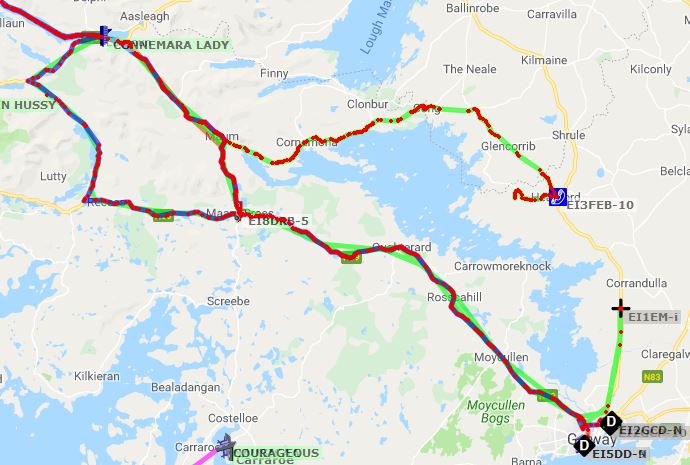
The course for the event is as depicted below and shows the starting points for each of the Marathons.


This is by no means new technology, but a  new addition to our operation this year. The reason for employing the Automatic Packet Reporting System (APRS) was to save a lot of irrelevant chit chat on the air. Quite often an operator is asked where he is and, unless he knows the area well, his answer would not exactly pinpoint his position unless he gave GPS coordinates. Indeed there is a slight lag before a position appears on the map but this is not "Air Traffic Control" so the lag is unimportant. This was a great improvement from a Net Controller's point of view.

APRS is, as we all know, and indeed take for granted, a system which will allow the positions to be sent to the APRS server and plotted on Google maps via the Click >> APRS.fi resource. Unfortunately unless one has a major conglomeration of APRS digipeaters, the only way to make any use of the APRS system is to use the mobile phone App "APRS Droid" which is downloadable via Google Play.

Two systems were in use during the event; mobile phone data was one and the other was the Android operating system of the TM7 Internet radio. Both systems worked equally well as they used the data system of the cellular network. It was suggested that the APRS facility was switched on as soon as one became mobile and en-route to the activity in Maam Cross to save anyone having to worry about the time operators were going to arrive. Any inquiries from organizers or marshals in the field regarding the location of different sections of the marathon could be dealt with immediately or even displayed on a tablet or mobile phone

Here is an example of the screen showing the activity throughout the day.


This satellite view looked better but not as practical from a net controller's point of view. It is obvious why VHF communications are not the system of choice. Ground wave on 80 metres is the ultimate system for use in this terrain.


There are a combination of tracks from all of the operators who took part. As the activity was in progress it was possible to see the individual call signs progressing along the route. Whilst at the individual road junctions, it was possible to show the Gardai where the runners were located and how long it would be before the traffic would need to be halted to let them past.

Two systems were in use during the event so mobile phone data was one and the other was the android operating system of the TM7 Internet radio. Both systems worked equally well as they used the data system of the cellular network. It was suggested that the APRS facility was switched on as soon as one became mobile and en-route to the activity in Maam Cross to save anyone having to worry about the time operators were going to arrive and where they were at the time.

The level of competitor fitness certainly was impressive, with the majority of entrants completing the course earlier than previous years. However, there were a few stragglers and these were monitored right to the homeward stretch in the Maam Valley. The numbers were relayed to the finish line before the net was closed. All credit must go to the organizers of the Connemara Ultra Marathon as they have absolutely every angle covered to ensure safety and smooth operation of the event to give the entrants the best of facilities for their efforts.

The map below shows the APRS tracks of operators from leaving home and returning


The trip home provided an opportunity for more relaxed conversation on C4FM and comparison with the TM-7 system.


The Net Control Station with  FTM 100 for VHF, Codan 9780 on HF, Inrico TM-7 on PTT over Cellular and APRS display on the Laptop.

The antenna systems were a vertical co-linear for the VHF Band and an Inverted-Vee for  HF. Easy to deploy and work very well in this area.


In Conclusion, HF is invaluable for full coverage of the Connemara area. VHF gives, at best, a  7.5 Km range with the occasional surprise in places. VHF is fine for dealing with small local problems and not interfering with the main running of the event, The TM-7 is good for the entirety of the region due to a large number of cellular systems in the area. It does not impinge on the main network and can be used to deal with localized problems as well as cover vast distances and into RF black holes.

DMR would have been used on this occasion but, of late, the Irish Brandmeister system had been taken off air for maintenance and updates on a number of occasions at weekends, which meant that this may not have been reliable enough to warrant its use. Perhaps, if a few more weeks had passed, we would have had more confidence in the system although switching our system to another Brandmeister Server may have been a better option.

Thursday, April 4, 2019

Teamspeak 3, Zello and Internet Radio

Internet Radio

Setting up cellular data to access live Amateur RF gateways or repeaters across the world can be easily done. A PTT enabled phone will make it even more like radio operation. It should be borne in mind that this is not Amateur Radio "as we know it" but is an alternative that allows those who don't have the space to set up antennas, or live in heavily restricted areas, to access amateur radio Repeaters or Gateway systems via the internet. It is communication at the end of the day. This is a little like operating a "Flex Radio System" from an Android tablet or mobile phone.

Internet Radios can be operated from the WiFi system in the house or via data from the Cellular Network provided a SIM card is installed.

Setting up The International Radio Network (IRN)

Download “Team Speak 3”. It’s available for Android, iOS, Windows and Mac.

Add the IRN Server. Details are as follows:

Label:           IRN CrossLink Server 
Address:       irn.ts.io (all lower case)
Password:    leave it empty
Nickname:    CALL SIGN – Your Name e.g. EI#XYZ –Fred

After connection to the IRN Server, you will be directed to the Welcome Channel. It will not be possible to operate any other channel until you become registered. 

KB1UPZ - Bob is the administrator so call him and introduce yourself with Name and Call sign. Provided that you are listed on QRZ.com as a licensed operator Bob will register you immediately. 

There are a wealth of channels available and these may be accessed by hovering over the channel on screen and touching the screen to enter. Some may be locked and require a password but the majority are not.


The Internet Radio above has an Android Operating System. It is possible to add Echolink and Peanut options to this radio and also Zello. Of course it is possible to use Teamspeak 3 on the Android tablet and Windows systems thereby giving a wide access to many communications systems. The set up is exactly the same.

Below is a screenshot from Windows showing the variety of Talk Groups available. The Galway VHF Group has a permanent Talk Group on this system. It is generally accessible but occasionally Password Protected if there is a specific discussion or operation taking place.


Zello

Zello is another system which is not as secure as Teamspeak and anyone can set up a channel for private use. In fact, with the reduction of Solar conditions, many CB groups have set up Zello Channels where they can hook up and hold QSOs. Internet Radio is widely used by Truckers for exactly this reason. 


Setting Up Zello is simple

1) Go to https://zello.com/ and create a Zello account making sure to remember the password and it is best to use the call sign as the user name

2) The best version of Zello for Internet Radio is Zello V3.53 which is easily found by an Internet search

3) Log into Zello once it is loaded with User name and Password. It is possible to add contacts or Channels – the latter being specific Groups etc and Contacts are individuals

The Southern Ireland Repeater Group have  a channel on Zello and it is necessary to contact them to gain access to the channel. There will be no problem provided that you give them your call sign. This will give access to a large network of linked repeaters. Of late, the Zello access has become very popular and a fair amount of activity on the system is from android based equipment.


The Zello system can be operated from any android based system such as tablet or phone and internet radio. Zello is also available for use on Windows Operating Systems.

EchoLink

Echo link for Android may be downloaded to any Android system such as Tablet, Phone or Internet Radio. It is necessary to register with EchoLink to allow the program to work. This is a simple process of giving your details and uploading the front page of the Amateur License. 

Run the Echolink program on the Android device and fill in your Call sign and Password. and EchoLink will run giving all the options available. EchoLink also runs on Windows-based operating systems. 

Peanut

This system provides access to the D-Star Network and has been described as a previous posting on the VHF Group Blog.  

Current Galway VHF Group TM-7 Users

Steve EI5DD    Joe EI3IX    Tom EI2GP    Andrew EI3FEB    John MI0AAZ    

In Conclusion

Whilst Internet Radio is often branded as "Not Real Radio" by the "old and bald" and in fact, the "neo bald", it provides a means of communication to those with limited resources for antenna installation and who are dogged by QRM complaints. Irrespective of where in the world one wishes to operate, provided there is a cellular network there is access. Operating mobile does not require any external antennas making life simple. If one is away on the holidays it is possible to keep in touch with the hobby through the Internet radio system. If you have no license at all use Zello to set up a personal channel to keep in touch with family and friends. 

Whilst the only communications modes have been mentioned here, there are other Amateur Radio programmes available for Amateur Radio use such as APRS Droid, and it is further possible to add an RTL dongle and set up an SDR receiver system.

Tuesday, April 2, 2019

Peanut for Android and Windows Operating Systems


Those involved with Digital Communications often gravitate to one or more digital modes. DMR is relatively easy to get into with a large number of reasonably priced handhelds available. For some reason, the programming of the radio seems to be a stumbling block to operators who don't read the manual before trying to use it. Yaesu Fusion is another alternative and is possible to go straight on the air with very little effort  - The callsign must be entered before the radio can boot up. D-Star has always been expensive and the set up is a little more complex.

Enter Peanut, a new program produced by David, PA7LIM. Peanut is a project allowing a first impression of the world of Digital Ham radio. Peanut allows access to some D-Star Reflectors and specific rooms via an Android device  4.X or higher or a Windows System using O.S. 7 or higher. If the experience is good on Peanut then it may trigger an interest in the purchase of an ICOM D-Star radio. If there is no Repeater or Gateway nearby, then it is possible to access D-Star via a personal Hotspot such as a DVMega, MMDVM, or SharkRF Openspot.


On the Peanut, it is possible to talk with HAM amateurs around the world via an Android device or network radio. Some of the ROOMS are connected to DSTAR reflectors ( XRF076B, XRF076F, XRF71L, XRF070C etc.. ). You only need an Android device to use DSTAR and gain access to an output on a Repeater or Gateway. Perhaps some way down the line it will be possible to add DMR to the interface.

A DMR ID is required and available from here Click >> DMR Registration

D-Star Registration is also required and available from here Click >> D-Star Registration

A code is required for entry to the Peanut Network available from here Click >> Peanut Access Code

Inrico Internet radios, such as the TM-7 which employ the Android operating system, can be loaded with the Peanut App as seen below


Excellent results have been obtained with the Inrico systems and, indeed, any other brand or Internet Radio. There are two handheld internet radios working from the data over cellular system in the form of the Radio Tone RT-320 and the Radio Tone RT-4. A review of the Inrico TM-7 and the Radio Tone RT-4 may be found in a previous posting on this Blog. Internet Radios will, of course, operate from the home WiFi system without the need for a SIM card. Those who have difficulty setting up antennas at home due to restrictions or setting up in a mobile environment will find this system a splendid alternative. As previously mentioned, the Peanut app will work on an Android Tablet and a Windows computer. 

A Peanut Dashboard may be found at >> Click Peanut Dashboard

A typical screenshot from the dashboard is shown below


Always plenty of activity most hours of the day. Whilst this program was only an experimental system, it gained momentum prior to the Christmas 2018 period. There were huge demands to keep it going and work will continue. The current stable version is V1.55 but newer versions are currently under beta test prior to release.

Where to Start

Obviously, the two English Reflectors "English" and English 1" will produce good results but do try Reflector "HBL2351" which connects into the CQ-UK Yaesu Fusion network. The CQ-UK Wires-X room has 37 or more Nodes connected all across the UK and there will always be some activity present. Sometimes the Australian Nodes connect to CQ-UK in the evening resulting in even more choice.

Peanut for Android is available from Google PlayStore.

The Offical Peanut Facebook Group may be found >> Click Here

Thursday, March 28, 2019

Considering Portable Operation

Portable operation

Portable operation is probably the best option when one has a postage stamp back garden and located only 7m A.S.L. From a VHF point of view, the obvious choice is a high location with the use of a 20ft telescopic "lightweight" mast secured with a drive on mast support. This is not the ideal height for 2 or 4-metre operation but will suffice for most operations on 70cms and frequencies above and is quite manageable for a solo operation. 

H.F. operation requires careful consideration of antenna types for use in the field especially if the activity is going to be a solo operation. Vertical antennas would be the first option and these may come in several forms. If there are trees around it is possible to support a variety of antennas. Unfortunately, the west of Ireland does not have an abundance of trees in useful portable locations so other options are considered.

The Kite Antenna

The Kite antenna is an excellent choice as it is possible to hoist up a quarter-wave antenna for top-band using a Sled 24 Kite. A set of 1/4 wave elements for 160, 80 and 40 metres would not take up an excessive amount of room. Even a random length of wire with an ATU gives reasonable results. A kite is quite manageable by one person alone but the obvious precautions of ensuring that there is a bleed system to remove static from the antenna. A bleed resistor of at least 1 M-Ohm would be required.


Naturally one should ensure that the kite is flown well away from power lines or obstacles.

A typical set up would be as shown:
There are a couple of choices of kite, but the Power Sled 24 available from Premier Kites is lightweight and very portable with no breakable parts. The Sled Kite is very stable in flight and doesn't dart around the sky if there is a sudden gust. The Sled 36 is much bigger and capable of lifting heavier wire antennas but can be difficult to reel in if there is any appreciable wind speed. The Cody Kite or the box kite are also very good alternatives and are generally quite stable.


The Fibreglass Pole

A 10 or 12-metre Fibreglass telescopic pole is a good basis for a portable antenna system. It is possible to wind a 1/4 wave length of wire in the form of a wide-spaced coil around the pole to form a vertical which is fed at the bottom.


The Fibreglass Pole may be used to support an Inverted-Vee antenna


A sloping dipole is also possible using the Fibreglass pole:


SOTA Beams produce a three-band dipole that may be used as a sloper or an Inverted-Vee. The different bands are selected by adding links in each leg.

The Windcamp Dipole

This is a small and simple lightweight dipole with a 1:1 balun at the centre.


Tuning is achieved by unwinding the antenna to points indicated by clour coded shrink wrap on the wire.


This is easily stowed in a back pack with a length of feeder and possibly a lightweight SWR Bridge.

The Buddipole

The Buddipole is a professionally constructed portable antenna for 40 to 2m which has found huge popularity worldwide. The exceptionally good quality and care of details make this antenna an ideal companion for vacations and other portable activities. The transport length of the dipole is only 56cm, with a weight of only 900 g nearly any pole is suitable for carrying it. A coaxial cable (380cm) with PL and BNC connectors is supplied, equipped with a choke on the antenna side. Power rating: 250W.

All items can be stowed in a carrying bag which makes it easy to transport.


All of the contents piece together to make a coil loaded dipole making it easy to tune to the various bands of choice. Coils are available for 80 and 60 metres and spare parts are available to extend the capabilities of the kit.


The buddipole is pictured above with all components in place. The coils in each leg may be tuned by moving links up and down the length of the coil to resonate on the desired frequency as shown below:

HF Equipment for Portable Use

The transceiver is a matter of choice and can be either QRP operated from a 12-volt battery of perhaps something capable of a higher power.

The personal preference that would cover all requirements and operate from a larger car battery would be the FT817 and a Tokyo High power Linear amplifier.


The FT817 ND QRP Transceiver covering HF bands from 1.8 to 30 MHz plus 6m, 2m, and 70cms. This transceiver has an internal power pack but it is better to have a 7 AH lead-acid gel battery to ensure adequate operating time. The LDG tuner is powered by AA cells and a great addition to the kit.

To increase the output for more serious portable activity the Tokyo HF50L can be added inline to give 50 watts P.E.P. output.  Sadly the Tokyo Hy-Power company closed in 2013 and these linear amplifiers rarely appear on the market. Ebay occasionally comes up trumps but they are often very expensive.

Both the FT817ND and Linear amplifier are an excellent combination for both voice and data communications.

The addition of the a Signalink USB driven by a portable notebook will be used to complete the set up.


Driven by a suitable data modes program, the signalink USB is a versatile system and additional programs such as JT65, FT8 and the WSPR suites, the best of QRP data modes may be enjoyed.


Of course one could go one better and employ an ARD 9000 Digital voice modem to the system. Whilst this is not hugely popular there is still some operation in this area and the results can be impressive at QRP levels.


With all the equipment in place it will be necessary to make up a Go Kit to contain the whole station in one easily deployable case. Watch this space for the next part of the project. A few large heavy duty plastic cases, a similar size to the TW7000 case, had been purchased from Maplin Electronics before they closed in Galway

In the mean time a shack in a case is already available in the form of the Transworld TW7000 which is an ex-govt HF transceiver operating from both mains and portable power. The power supply and ATU are built into the system. This is however not the most portable system as it is fairly heavy.

Everything required for a portable operation is in the case including a rapid deployable length of wire with a throw weight easily tuned for the HF bands. The power supply will auto sense the mains voltage. The Aut0-ATU will tune any random wire length. This is an excellent system for communication on all HF bands and capable of 125 watts P.E.P. output. There is also an ALE system built in but probably better with a pre-tuned multi-band antenna for the bands required.

Hopefully some reasonable weather for the fortcoming year will make portable operation more attractive.

Tuesday, March 5, 2019

Kinvara Rock and Road Marathon

The Galway VHF Group provided communications for the Kinvara Rock and Road Marathon. EI1EM John, EI8DRB Gerry followed the Full and Half Marathons with Net control on the fly - EI5DD Steve. There was a link to the Order of Malta Ambulance Service via Net Control. The terrain was perfect for VHF operation and our C4FM equipment which worked very well. No incidents or injuries occurred despite the heavy rain in the earlier part of the Day. 

There were plenty of opportunities to check out the Digital Projects in Galway and also an opportunity to work Joe on Croagh Patrick, and Phil in the Sligo direction on 70cms. The equipment worked well and it was comforting to know that the projects on high ground continue to provide excellent coverage. 

The APRS tracks for the day. I include these because a certain organisation, beginning with "A", for some reason, doesn't believe I can use this system! Here is proof! The tracks south of Galway Bay is the Full and Half Marathon courses - anything north is us going home. It would appear that John decided to go for the more sophisticated route home by helicopter judging by the green track.


Wednesday, February 6, 2019

Galway Fusion Net and Call Channels


A local Galway VHF Group Yaesu System Fusion Net will be held on the Galway Repeater EI2TBR operating on 145.625 MHz each Wednesday at 8pm. The purpose of this net is to disseminate VHF Group  information and have a general VHF Group social get together once a week. This will reduce the need for regular meetings but promote regular activity on the airwaves. All are welcomed to join.

Calling Channels

On Fusion the Galway Repeater 145.625 MHz

On DMR Talk Group 2724.

This Talk Group is linked to Wires-X Node CQ Ireland and YSF Ireland resulting in Fusion operators bridging across to DMR which should bring even more activity to the forefront

By monitoring these centres of activity, regular contacts should be guaranteed. 

Friday, November 16, 2018

Galway Digital Net


The Galway Digital Net, held on Monday evenings at 8:30pm, is an ideal way to allow both DMR and Fusion Operators to operate on one Net via the Bridging systems currently in place. 

DMR users can access using TG 2724, Yaesu Fusion Operators can link into the CQ-IRELAND Room (Node 41411), those using the DVmega or Shark RF OpenSpot can access via YSF-IRL. These are all linked together via Bridges. It is possible to link in via Echolink node 883269 or MI0AAZ-L this will cater for Analog users. 

From a Galway point of entry the following can be used. 

Galway DMR Repeater EI7RHD I/P 430.450 MHz O/P 439.450 MHz

TG2724 on Slot 2

Galway Multi mode Digital Gateway EI2GCD on 144.850 MHz

This Gateway defaults to YSF-IRL just transmit a Fusion signal in

Galway Wires-X Gateway EI2SHD on 144.8125 MHz

Press the X button to connect. The Gateway defaults to CQ-IRELAND this will appear on the transceiver's display.

The Galway Fusion Repeater I/P 145.025 MHz O/P 145.625 MHz

The Galway Fusion Repeater is, by default, linked into the CQ-IRELAND Node.


It is important to leave a three (3) second Gap between overs to allow the network components to reset. so "PLEASE MIND THE GAP". If this is not observed chaos will ultimately occur as the network drops overs and only parts of the conversation come through.

Secondly, Set Time-out timers to 180 secs (3mins) as network components all time-out after 3 mins and the rest of the over will be lost. 

This net facilitates a great opportunity to ask questions about the network and its direction. An opportunity, also, to test the resources available and include all members of the digital fraternity on one system.

Here is the dashboard of the Gateway showing the call-ins on Monday the 18th of November 2018


A good turnout on this occasion.